Showing posts with label guest post. Show all posts

Saturday, March 19, 2016

Demonic Bookcases, Part 2

Part 2 of guest blogger Kathryn Ptacek, a writer who lives in rural northwest New Jersey and shares her old Queen Anne home with lots of books, the requisite author cats, teapots, and the occasional visiting mouse.

She's tackling the most common writer clutter problem: Crowded bookcases.

Demonic Bookcases, Part 2
by Kathryn Ptacek


One of my "supervisors"
Let me back up just a bit. Before I started the decluttering, I sat down and made a diagram of the bookcases in the living room, dining room, and front hall (the last of the tall bookcases is there). I estimated how many letters could go in each bookcase, taking into account that there seem to be numerous authors with names beginning with H and M and S. They would need slightly more room. T through Z authors go out into the front hall. As I went through the shelves I found a lot of books I could put out there in the hall—they'll be dealt with later.


Shelf 1, After
After investing in many long hours of scrubbing shelves and wiping dust off books and bending and reaching and clambering up and down a stepladder, I finally finished the first bookcase. Hurray! I put back a few teapots. It's great to see some of my collection now—and truly be able to see each piece.

The next day I started work on the second bookcase (D, E, F, G, and some H). That's finished, and I set out some teapots selectively and took photos. Now, I'm about to finish the third bookcase, and I've already swept everything off the last bookcase in the living room and the one in the dining room. The one in the front hall will have to wait a while. It seems to have ended up with a massive amount of things, some of them refugees from the other bookcases. I'm going to need a bigger box, I guess!

Living Room, After
As I've gone through more books, I found some that were by A, B, and C authors, and I've set them on that bookcase. There are now about thirty of them, with no room on the shelves. That means I have to cull at least thirty books from there. Again.

Am I happy to be getting rid of some of these books? In one way, yes, because I feel a tad "lighter."  I've heard people mention that they feel they have less of a burden on them when they dispose of something, and I can understand that. But I love my books, and I am parting reluctantly with them. All this would be solved, of course, if I could just swing some floor-to-ceiling bookcases. I have a Queen Anne–style Victorian, so the ceilings on the first floor are high, and those bookcases would be huge! As it is right now, I look at the foot-plus space over the doors and windows and think about all the books that could rest nicely there. Well, perhaps if I win the lottery ... Some books, though, I'm boxing up, such as the Ellery Queen paperbacks. I want to keep them, but I don't want that multi-book series on the shelves. Is this cheating? I'm not sure, but I can't have it both ways, I guess.

Front Hallway, After
So now I hope to finish the M authors in a day or two, then move on and get to the end of the alphabet by next week. I have some deadlines looming at present, so I've had to cut back my book sorting time. (One night after I'd just started all this, I worked until 2 a.m.) On breaks, I'll head downstairs and cull a few more books for a while. It's a fun task where I don't really have to think too hard about anything.

And my goal? Not to allow the stuff to creep back onto the shelves. I want to display my collection of teapots. What's the sense of collecting something if you and your friends can't see it? That won't be easy, but I'll keep trying. The hardest thing, though, will be that when I buy a new book and bring it into the house, I know I'm going to have to get rid of at least one or two old books. But I'll manage. What's a few more books into the culled pile, right?

Of course, now I have all those boxes of shells and stones and keys to sort through ... That's my next challenge!

   
##


Kathryn's novels are now out as ebooks from Crossroad Press and Necon Ebooks. Her first collection of short stories, Looking Backward in Darkness, was released by Borgo Press in 2013. She has short stories in two recent anthologies: Fright Mare and Expiration Date.

She can be reached at gilaqueen@att.net or through her Facebook pages.

Tuesday, March 8, 2016

Demonic Bookcases, Part 1

Today's guest blogger is writer Kathryn Ptacek, who lives in rural northwest New Jersey and shares her old Queen Anne home with lots of books, the requisite author cats, teapots, and the occasional visiting mouse.

She's tackling the most common writer clutter problem: Crowded bookcases.

Demonic Bookcases, Part 1
by Kathryn Ptacek

I love books! Big, short, thick, old, new, illustrated... books, books, books! I collect them, and it shows, because I have them everywhere in my house. Every room has at least one bookcase in it, and some have as many as six or seven. Only the bathroom remains bookless.

My late husband was also a horror writer and also a book collector, and when we moved to this house, we had little furniture–but we did have dozens of boxes of books. Those numbers increased over the years, and all those volumes piled up. On the bookcases, under tables, and on the floor here and there.

Fast forward decades, and now I'm surrounded by dusty tomes, and I'm kind of drowning. I love books, but I can't have them everywhere. I especially can't have stacks on the floor where the cats and I can knock things over, or in my case, where I can trip over them.

So I decided to cull my collection. Several years ago I started working on the hardcovers in the front parlor. The fiction hardbacks are there, while the fiction paperbacks hang out in the adjacent living room; nonfiction books reside upstairs in the two offices. And the guest room. And the hallway. I boxed up a lot of books and sent them off to a fellow to sell at auction. It was one of the hardest things I've ever done.

The first time I picked up a book to put in a box, I was sure I heard Charlie's voice saying, "No, not that one!" But, yes, that one. And the one next to it, and the one under it, and the three off to the left. I sent dozens and dozens of books to the auction guy. Then I stopped working on the books, and even though I wasn't buying many, they still seemed to show up downstairs. (Could books be like clothes hangers and multiply in the dark? Possibly.) Then just a week or so ago, I was staring at the bookcases in the living room and decided I needed to alphabetize these books... and then I could get rid of some.

Living Room, Before
Another problem? An incredible number of knickknacks clustered in front of the paperbacks. It was getting to the point where sometimes I could barely see the book. Somehow, objects in my hand as I entered the living room always found their way to the bookcases. What to do with the extra key to the garage? I'll put it on this shelf so I can find it if I happen to lose the other key. Oh, well, I've just come across some interesting keyrings—maybe they should go with that extra key- just in case. Flashlights? I need them at hand in a single location for when the power goes off. Little emergency radio? Better put it with flashlights so I can find everything together. Small lantern? Goes with the emergency stuff!

Seashells? On the bookshelf! Interesting rocks found on walks? Next to the shells! What's this piece of plastic? Don't know. Put it on a shelf until I can figure out where it belongs. It's a never-ending cycle. Or so I thought.

Front Hallway, Before
Last week I grabbed some cartons and removed all the stones and pieces of wood and seashells and cat figurines and keys and teapots that had piled up over the years. Into the boxes! I'll deal with them later.

Then I started pulling books off the shelves and shifting them around. The authors with "A" and "B" and "C" last names go in this one. "D" names start on this other bookcase. Can't fit them all? Time to figure out which authors I no longer love.

It's hard to part with the books. I just might read some of these in future, even though I've only had some of these books for thirty years.

But I've hardened my heart. If I truly can't stop thinking about some classic, well, there is the library. I can't own every book, right?
   
##


Kathryn's novels are now out as ebooks from Crossroad Press and Necon Ebooks. Her first collection of short stories, Looking Backward in Darkness, was released by Borgo Press in 2013. She has short stories in two recent anthologies: Fright Mare and Expiration Date.

She can be reached at gilaqueen@att.net or through her Facebook pages.

Monday, August 17, 2015

Decluttering, Or Getting Rid Of The Dead Weight

Today's guest blogger, author Jennifer Allis Provost, tackles the random junk in the kitchen.


Decluttering, Or Getting Rid Of The Dead Weight
Jennifer Allis Provost

As writers we tend to hold on to odd bits of minutia, whether it's a notebook of story prompts, a feather we found in the yard, or a souvenir from a trip we took twenty or so years ago.  Memorabilia's nice and all, but if we're not careful we'll end up with a house full of random junk— which is exactly what happened to me.

I've been working on my kitchen for the past few months, and anyone who's ever been in my kitchen will understand why. It's been half done for about six years, being that having twins is the single best way to lose time, funds, and motivation for home improvement projects. A few weeks ago I said to myself, "Self, this is it. By the end of 2015, I will have a kitchen I'm proud of." However, before I could tackle things like my atrocious ceiling and the half-tiled back splash, I had to deal with the clutter.

What sort of clutter, you ask? Daily progress reports from the Wonder Twins' pre-K teachers, assorted birthday cards and invitations, and enough receipts to evidence a truly debilitating shopping addiction (shoes...I needs all the shoes). But the mecca of clutter, in my kitchen at least, was the wine cabinet.

This wine cabinet was given to me by a less-than-favored in-law about ten years ago, with the explanation, "I know how much you like wine, and it was on clearance at Target." At that time I think I'd had all of three glasses of wine in my life, and hadn't liked any of them. Anyway, I accepted the gift, stuck it in my kitchen and filled it with all sorts of junk. Ironically, no bottles of wine ever made it into the cabinet, but it has housed Limoncello.

Mmm, Limoncello.

So instead of housing the intended wine, said wine cabinet ended up as the resting place of many oddities I accumulated over the course of my writing career. Within the bowels of the cabinet I found a Russian phrasebook (I took Russian in high school, along with French and Italian) that was used to assist a fellow author, a Gaelic dictionary (I taught myself Gaelic for a different project), random name tags and program booklets for 10+ years of writing conventions, and enough bookmarks to choke a horse.

Non-writerly stuff included mismatched tablecloths and placemats, keychains, half-burned candles, a crap ton of office supplies, and an assortment of odd-shaped glasses.

Yeah. Basically, it was a heap of junk.

Here's how it all shook out: I washed the glasses, and put them with...wait for it...the other glasses. I put the books on the bookshelf, the candles in the candle drawer, and recycled the program books and name tags; seriously, if I need to know who the Arisia GOH was in 2006 I'll Google it. That's what the Internet's there for. I also threw the tablecloths and placemats in the wash and then the linen closet, and added the bookmarks to my swag box. Then came the most awesome part of this project:

My husband and I destroyed the cabinet and dumped it in the trash.

The moral of this story is that not only was I holding on to things I didn't need to (for example the program books), I was also being lazy and dumping things in the cabinet rather than putting them away properly. If you want to be a successful writer, or artist of any type, a modicum of organization is necessary. And keeping a heap of junk in your kitchen is not conducive to anything but accumulating dust.

Besides, if you're going to add furniture shouldn't it be a bookcase? Now that's my kind of clutter.


About Jennifer:

Jennifer Allis Provost writes books about faeries, orcs and elves. Zombies too. She grew up in the wilds of Western Massachusetts and had read every book in the local library by age twelve. (It was a small library). An early love of mythology and folklore led to her epic fantasy series, The Chronicles of Parthalan, and her day job as a cubicle monkey helped shape her urban fantasy, Copper Girl. Her latest release, Heir to the Sun, was released June 1, 2015 by Bellatrix Press. Her next release, Changing Teams, will release November 10, 2015 from Limitless Publishing. Find her on the web at http://authorjenniferallisprovost.com/.


Wednesday, July 22, 2015

Faux Decluttering

Today's guest blogger, author Catherine E. McLean, describes her secrets on how she tames clutter in a tiny working space.


Faux Decluttering               
by Catherine E. McLean

I bet you read the title of this piece and thought, "faux" means "fake," so how does one fake decluttering? Clutter is clutter.

Okay, so we writers are sometimes packrats, if not bona fide hoarders. Especially when it comes to juicy tidbits that spark our imagination. We find research so fascinating that we make copious copies of it to keep. And we constantly hear that little devil's voice whisper into our ears, "You'll need it one day."

I am fortunate to have an office in my home. Okay, in reality, it's a glorified closet— eight feet wide by sixteen feet long. The door at the end faces a small window on the opposite wall. Yet, in this space is a big four-drawer desk, a file cabinet (vertical, four letter-sized drawers), a work table for the cutting board and typewriter, my desktop computer, its tower and monitor, two printers, and six bookshelves. My office chair has just enough room to swivel from the desk to the computer station and back. Not quite a knee-knocker turn.

Of the six bookshelves, three are a foot wide (originally they were video towers. Two were placed to form a square base against the back corner wall. One unit is fastened on top of the two, allowing for more books, and a little shelf space— for the alarm clock and Office Minions (cute knickknacks, like a space alien reading a story to a robot).
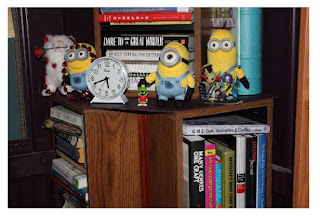
The three video units, plus the other narrow bookshelf house forty "keepers," the books on writing craft. The books are the top picks out of the four hundred that I have studied. They're handy references when a fellow writer has a question or wants a definitive source on an aspect of writing fiction.

The computer desktop was originally a kitchen countertop, one that had been ordered but, because of an error, was too short. I wasn't letting something that nice go to waste. So, I had shelf units built to the correct ergonomic height for my keyboard, which means I work comfortably at the computer for hours on end.

Those shelf units hold my enormous American Heritage Dictionary and my thesaurus, manuals for my office equipment, and boxes of clipped "settings" (scenic pictures from calendars and magazines like National Geographic). After all, a picture is worth a million words.

Also stored (that is, crammed) into my office space is my writer's "stuff." It lines the walls and tops of bookshelves. Yet, the secret to keeping my office ergonomically unfatiguing and efficient comes from a kitchen remodeling workshop I once attended. The secret is— work centers.

In essence, my office is arranged into work centers. My desk is for the business of writing. My computer station is for creating tales. Everything for the printers and printing is on the bookshelf next to the printers. I don't get out of my chair to reach the reams of paper, card stock, address labels and business card blanks, brochure papers, etc.

When I turn around from my computer, I face the largest of the bookshelves. It holds bulging three-ring binders, half have four-inch spines. Those contain my story worlds. Stacked on top of the bookcase are more binders— copied information, each one on a specific story element, to help me put the story together, revise it, do the synopsis, etc.

The space under the cutting table's legs shelters three old cardboard file drawers sitting side by side. One drawer holds the overflow from the file cabinet. Another holds clear plastic envelopes (within are hard copies of stories that came to life but are missing elements, which keeps them in limbo, at least for now).


The third file drawer holds an assortment of miscellaneous stuff— like inspirational mottoes that can be pinned on my walls. (No mottoes have to do with being neat or tidy!)

Other "work centers" include a drawer of CDs— backups of the computer's story files. You see, I don't believe in "the cloud" for backups or storage. Computers crash when least expected. Nature and hackers are a threat.

All right, I'll confess. I have an external backup drive. Trouble is, I don't trust it either.

Another work center is the vertical file cabinet. One and a half drawers house correspondence (a lot of it decades old, which I really should purge). The other drawers contain alphabetic files of information on subjects like animals, food, runes, weapons, etc. Such material brings stories to life because I can see pictures as well as read descriptions.

Now you're thinking all I've done is organize my office. No, sorry, it's still cluttered because things are stuffed, crammed, and compressed into containers, which are haphazardly stacked, shelved, or hidden in drawers.

But, you know what? That's faux decluttering at its best!


About Catherine
In addition to being a wife and mother, Catherine has ridden and exhibited Morgan Sport Horses. She is an avid clothing and costume designer, an award-winning amateur photographer, a 4-H leader, and a Red Hatter who loves bling.

Catherine lives on a farm nestled in the foothills of the Allegheny Mountains of Western Pennsylvania. In the quiet of the countryside, she writes fantasy, futuristic, and paranormal stories where a reader can escape to other worlds for adventure and romance.

Book Launch

Love, vengeance, attempted murder, and a bomb . . .  No reason to panic.

Join Catherine for an online Release Day Celebration at the HEARTS AKILTER BLOG,  1-5 p.m. EST on August 5, 2015.

Participate in the Release Day Celebration and get a chance to win a $50 gift card giveaway and other prizes. See the Release Day Celebration page for more information.

Tuesday, July 7, 2015

The Socioeconomics of Clutter

Maybe your personal space is cluttered because you just haven't had the time to declutter, but maybe there are deeper reasons. In the second of my guest blog posts, Justine Graykin, Writer and Freelance Philosopher, muses on the connection between clutter and socioeconomics.

The Socioeconomics of Clutter
by Justine Graykin
justinegraykin.wordpress.com

I have a theory: Clutter is directly related to how much money you have.


It's not that poorer folks are necessarily messier than rich folks.  It's just that they have a harder time throwing stuff away.  After all, you might need it.  It might be useful someday.  And you might not be able to afford a new one.

When money is less of an issue, you don't worry about throwing away something potentially useful.  You can always buy another.  And chances are, you have a bigger house anyway, with more places to store your stuff.  Including all your kids’ art projects and report cards, and your dad's collection of WWII memorabilia.  Run out of room?  No problem.  Get a storage unit.  Get two.  Get a second home to fill with the spillover from the first. 

Is your clutter getting disorganized?  Tired of dusting all those tchotchkes (I love that word!) that you've collected?   Hire somebody to take care of it all.  Or pack it all up and donate it to charity.  Makes a great tax write-off.

But when your income does not include a surplus for housekeepers, storage units and second homes, or when you've endured a long stretch of poverty that has ingrained the hoarder's habits, it's tough to throw stuff out.  You save it for a rainy day.  You think, "Someday I'll be very glad I held on to this."

There are those houses you pass with cluttered yards.  When you're poor, and you need to keep that car, that mower, that appliance, running for as long as possible, and you need to fix it yourself because you can't afford repairs, you keep a lot of spare parts around.  Get a new (probably refurbished) washer?  Better keep the old one.  Might be some useful parts in it. 

Eventually, all those potential sources of parts (or maybe they could be fixed when you get around to it) sit in the weather for too long and disintegrate into junk.  But then what do you do with it?  Can't take it to the dump.  The dump charges you for the disposal of large items.  Towing away all those junk cars would cost money.  So there they sit, slowly becoming part of the landscape.

And giving the neighbors fits.  "The place is an eyesore!  Why don't they get rid of all that unsightly clutter?"  I'm betting the income of those who complain is higher than those they complain about.

So, writers.  Writers accumulate stuff just like everybody else.  Probably even more so, because writers are notoriously eccentric.  So what they collect, on top of all that potentially useful debris, is eccentric.  Writers also tend to be a sentimental, sensitive lot.  Goes with the territory.  So they keep the origami rose their youngest child made for them, the first draft of their first ever published novel, the cups from the BarFleet party at Arisia, the model of a real castle picked up in Scotland, MLP figures, business cards of every single person they ever met at a convention, mouse skulls, butterfly wings, sea glass, plant pots, pressed leaves and flowers, silver streamers from the Blue Man Group concert,  bookmarks, a handmade change purse from Mexico with Dia de los Muertos figures on it, and crates of books they'll probably never (but they might!!) read/reread.

And, of course, pens.

Now, none of this would be a problem if writers earned lots of money for their work.  They'd just get nice display cases for their eccentric stuff.  And as for the pens, well, who needs pens, anyway, when you've got all the latest devices?  Oh well, maybe to sign those books for fans.  But you have that deluxe gold pen you were awarded at some posh ceremony or other.  Keep that of course.  The rest?  Pitch them.  You can always buy more.

Writers, however, do not earn buckets of money for their work.  So, clutter.  For all the reasons of clutter.  And decluttering?

Good luck with that.

Wednesday, June 24, 2015

Paperwork, Be Gone!

I don't have all the answers; there are still many de-cluttering problems I haven't figured out yet. So, being the crowd-sourcing type of person that I am, I reached out to the broader writing community to find out how other writers handled their clutter problems.

Sometimes you just can't do it alone. Writer Loren Rhoads found her answer in a professional organizer.

Paperwork, Be Gone!

by Loren Rhoads

For 10 years, I edited Morbid Curiosity magazine.  It collected true first-person essays, which I published annually in the spring.  The last issue appeared in May 2006, after which I collected my favorite essays into an anthology published by Scribner in 2009.

During the magazine years, I kept a paper copy of every draft of every submission I’d ever received, whether I eventually published it or not.  I kept every web page I’d printed out as research.  I kept reams of correspondence, particularly from difficult would-be contributors and/or all the prisoners who’d ever gotten in touch.  I kept copies of every invoice I sent and resent to the deadbeats who wouldn’t pay for the magazines they’d ordered for their shops or distribution schemes. Most of the paperwork was in rough order, but there were duplicates and redundancies and stuff I just didn’t need any more.

It felt like, to use the vernacular, an epic heap of fail. I told myself that I couldn’t tackle it, because there was no way to overcome it by pecking at it an hour or two at a time, as watching my daughter allowed.  The real truth was that I didn’t want to wallow in all the unhappiness, bad memories, and feelings of inadequacy the paperwork represented.  My magazine was a success, in that it was beloved and developed its own cult.  I just wasn’t as successful at the business of publishing it.  I naively wanted to believe the best of distributors and shop owners, especially if they were enthusiastic and complimentary. I didn’t want to look at the record of my struggles.

Luckily, a friend of mine started a business as a professional organizer. I hired her to come by one day to help me master this disaster.  It was the best money I’ve ever spent.

On that magical day, Lilah went through all seven boxes of papers, as well as the four jammed file drawers, without judging, reading anything, or becoming involved in any of it.  She made piles for me: one for each issue, with reviews, ephemera from the readings, photographs, and fan letters.  I decided to pull out the best parts of those piles and make a scrapbook, so I could look at my triumphs when my spirits needed a boost.

She also made piles of each year’s receipts and invoices.  Filing that stuff away was the best experience of my life. The unpaid invoices went into the tax paperwork, never to be looked at again.  When the IRS’s suggested length of time passes, I’m going to pitch those files in the bin without even opening them. 

Lilah made a pile of edited manuscripts, any hard copy illustrations that the artists hadn’t wanted back, and advertisements for each project.   Among that stuff were the rejected manuscripts or things I’d started to edit before the contributors became too challenging to deal with.  I simply threw those things away.  Now I can forget the people who were mean to me when I dared to edit their deathless prose. Every time I recycled a sheaf of papers, laughter bubbled up out of my chest.  I said over and over, “YOU are out of my life.”

In the five hours Lilah and I worked together, I managed to throw out three full boxes of paper.  We whittled the keepers down to three boxes and a file drawer, along with two miscellaneous stacks that I needed to read more closely before recycling them.

Two weeks after the organizer came, I finished. My curbside recycling bin was crammed full two weeks in a row, but the purge has been very healing.  I cannot believe the feeling of liberation in culling all this stuff.

In the end, I can forget the frustration and depression and anxiety that marred the triumphs of my publishing business.  I only want to remember the good parts of running the press.  I have thrown all the bad memories away.

I know it can be intimidating to turn your paperwork over to someone else to handle, but trust me, they will be working too fast to judge.  Because there’s no emotional baggage for them, they can be efficient and ruthless.  Unless you empower them to actually throw things out, you will still be able to make the final call and rescue anything you need to.  However, once of the worst of the organization is done in macro-scale, the little decisions are easier to make.  Throwing things away takes on a momentum of its own.

If you aren’t lucky enough to have a friend who is starting her own business, there are professional organizers who can be hired.  More basic than that, you could hire a high school kid or trade organizational chores with a friend.  Anyone who isn’t emotionally bound by your paperwork is an ally. Agree first what the payment will be, how long you will work, and when you will take breaks. Then pull up your recycling bin and get to work.


 Loren Rhoads is the author of the space opera trilogy In the Shadow of the Templars. The Dangerous Type comes out on July 7, 2015, followed by Kill By Numbers in September, and No More Heroes in November. You can learn more about the series at http://lorenrhoads.com/writing/the-dangerous-type/ or Morbid Curiosity magazine at http://lorenrhoads.com/editing.